Innate Immunity

Cellular Recognition, Inflammatory Signaling, and Gene Therapy
Innate immunity is the body's first line of internal defense against infectious agents, cellular damage, and unfamiliar biological materials. It relies on a coordinated network of immune cells, soluble proteins, cellular receptors, and signaling pathways that detect potential threats and initiate appropriate biological responses.
In gene therapy, innate immunity plays a particularly important role because therapeutic delivery systems introduce genetic material and associated molecular structures into biological environments. Depending on their composition, location, and properties, these materials may activate immune sensors and trigger inflammatory responses that influence gene delivery, therapeutic expression, and overall treatment outcomes.
Understanding innate immunity is therefore essential for investigating immunogenicity in gene therapy. It helps explain how cells recognize viral vectors, detect foreign nucleic acids, release inflammatory mediators, and communicate with the adaptive immune system.
This page explores the fundamental mechanisms of innate immunity, the major cellular and molecular components involved, and their implications for the development of therapeutic gene delivery systems.
What Is Innate Immunity?
Innate immunity is an evolutionarily conserved defense system that responds rapidly to molecular and cellular signals associated with infection, tissue damage, or biological disturbance.
Unlike adaptive immunity, which develops highly specific responses through B-cell and T-cell receptors and can generate long-lasting immunological memory, innate immunity relies on a range of pre-existing recognition mechanisms. These mechanisms detect characteristic molecular patterns and activate responses that help contain threats and coordinate subsequent immune activity.
The innate immune system includes physical barriers, specialized immune cells, soluble defense proteins, and intracellular signaling networks.
Its principal functions include:
Detecting potentially harmful biological structures.
Initiating inflammatory and antiviral responses.
Recruiting immune cells to affected tissues.
Supporting the removal of pathogens and damaged cellular material.
Activating and shaping adaptive immune responses.
Contributing to tissue repair and the restoration of biological balance.
These functions are essential for normal immune defense. However, in therapeutic gene delivery, the same recognition mechanisms may respond to vector components or genetic material, depending on the characteristics of the product and its biological context.
Innate immune activation is not inherently harmful. Its consequences depend on the intensity, duration, location, and nature of the response.
Major Components of Innate Immunity
Innate immunity depends on the interaction of multiple cellular and molecular components. Each contributes to the detection, containment, or regulation of biological threats.
Physical and Chemical Barriers
The skin, mucosal surfaces, epithelial cells, and associated chemical defenses form important protective barriers. They help limit the entry of microorganisms and regulate interactions between the external environment and internal tissues.
Although many gene therapies are administered through routes that bypass some external barriers, epithelial integrity and tissue-specific defense mechanisms can still influence local immune responses and the distribution of therapeutic products.
Neutrophils
Neutrophils are rapidly recruited immune cells involved in the recognition and removal of pathogens. They can release antimicrobial molecules, produce reactive oxygen species, and contribute to inflammatory signaling.
Their activity is important in acute inflammation, although excessive activation may also contribute to tissue injury in certain settings.
Macrophages
Macrophages participate in the recognition and uptake of biological material, the removal of cellular debris, and the regulation of inflammation. They can produce cytokines and chemokines that influence the recruitment and activity of other immune cells.
Macrophages may interact with therapeutic delivery systems through uptake, processing, and signaling mechanisms. The consequences depend on the formulation, tissue environment, and biological properties of the material.
Dendritic Cells
Dendritic cells are important links between innate and adaptive immunity. They detect biological signals, process antigens, and present antigen-derived peptides to T cells.
Their activation state and surrounding inflammatory environment can influence the strength and character of subsequent adaptive immune responses.
In gene therapy, dendritic cells may contribute to the recognition of vector-derived proteins or other components of a therapeutic product.
Natural Killer Cells
Natural killer (NK) cells are innate lymphocytes that help identify and eliminate selected stressed, infected, or abnormal cells. Their activity is regulated by a balance of activating and inhibitory signals.
NK cells may contribute to immune responses associated with viral infection and, in certain contexts, therapeutic gene delivery. Their involvement depends on the vector, the target cells, and the surrounding immune environment.
Complement Proteins
The complement system is a network of soluble and cell-associated proteins that supports immune surveillance, inflammation, and the removal of selected biological structures.
Complement activation can occur through different pathways and may influence the interaction between therapeutic formulations and the host immune system.
For some gene delivery platforms, complement-related effects are relevant to evaluating inflammatory responses and product tolerability.
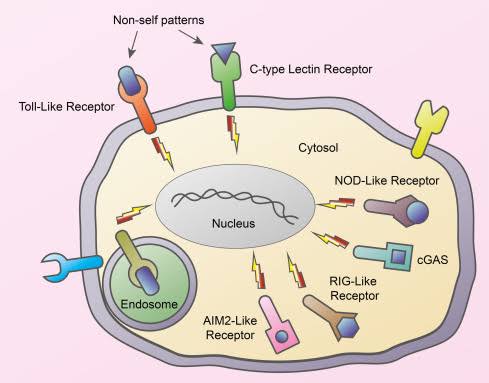
Pattern Recognition Receptors
Pattern recognition receptors (PRRs) are specialized receptors that detect molecular structures associated with pathogens, cellular damage, or other biological signals.
They are expressed by various immune and non-immune cells and activate signaling pathways that regulate inflammation, antiviral defense, and immune communication.
PRRs are particularly relevant to gene therapy because therapeutic vectors and their genetic cargo may contain or expose structures that activate these sensing systems.
Toll-Like Receptors
Toll-like receptors (TLRs) recognize a variety of molecular patterns. Different members of this receptor family detect distinct microbial or damage-associated signals.
For example, TLR3 is associated with the recognition of certain double-stranded RNA structures, while TLR7 and TLR8 recognize selected single-stranded RNA features. TLR9 recognizes particular DNA motifs in appropriate cellular compartments.
Activation of these receptors can stimulate intracellular signaling pathways that promote the production of inflammatory cytokines and type I interferons.
The response depends on the receptor involved, the cell type, the location of the material, and the molecular properties of the stimulus.
Cytosolic DNA Sensing
Cells also possess intracellular systems for detecting DNA in the cytosol.
The cyclic GMP–AMP synthase (cGAS)–stimulator of interferon genes (STING) pathway is an important mechanism for sensing certain cytosolic DNA signals. Following activation, this pathway can promote signaling that leads to type I interferon production and other inflammatory responses.
The pathway is relevant to research involving DNA-containing therapeutic systems, although its activation is context-dependent and should not be assumed for every gene therapy product.
RNA Sensing Pathways
RNA-sensing mechanisms help cells detect particular RNA structures or molecular features. These mechanisms include receptors such as RIG-I and MDA5, which can activate antiviral signaling pathways under appropriate conditions.
The resulting responses may include the production of type I interferons and other mediators that influence cellular antiviral defenses.
RNA sequence, structure, chemical modification, intracellular localization, and delivery formulation can all influence how RNA is detected.
Inflammasomes
Inflammasomes are intracellular multiprotein complexes that respond to selected cellular danger signals and activate inflammatory processes.
Some inflammasomes, including NLRP3, can promote the activation of caspase-1, which supports the maturation of interleukin-1 beta (IL-1β) and interleukin-18 (IL-18). Certain conditions can also lead to inflammatory cell death known as pyroptosis.
Inflammasome activation depends on the specific biological context and may be relevant when investigating inflammatory responses to selected therapeutic formulations.
Innate Immune Signaling and Inflammation
When innate immune receptors detect a relevant stimulus, they initiate intracellular signaling pathways that regulate gene expression and cellular activity.
These pathways enable cells to respond rapidly to biological threats and communicate with surrounding tissues.
NF-κB Signaling
The nuclear factor kappa B (NF-κB) pathway regulates the expression of numerous genes involved in inflammation, immune activation, and cell survival.
Depending on the stimulus, activation of this pathway can promote the production of cytokines and chemokines that recruit or activate additional immune cells.
NF-κB signaling is therefore an important mechanism for understanding inflammatory responses associated with biological materials and therapeutic delivery systems.
Interferon Signaling
Type I interferons, particularly interferon-alpha and interferon-beta, are important mediators of antiviral defense.
Their production can be stimulated by selected pattern recognition pathways. Once released, type I interferons interact with cellular receptors and activate signaling mechanisms that induce interferon-stimulated genes.
These genes contribute to an antiviral state and regulate multiple aspects of immune function.
In gene therapy, interferon responses may influence the cellular environment in which therapeutic genetic material is delivered and expressed. The magnitude and consequences of these responses vary with the delivery platform and experimental conditions.
MAPK Pathways
Mitogen-activated protein kinase (MAPK) pathways regulate several cellular processes, including inflammatory gene expression, stress responses, differentiation, and survival.
Depending on the receptor and cellular context, MAPK signaling may cooperate with NF-κB and other pathways to shape the response to immune stimuli.
These interconnected signaling networks demonstrate that innate immunity is not controlled by a single molecular pathway but by a coordinated system of cellular responses.
Cytokines and Inflammatory Mediators
Cytokines and chemokines are signaling molecules that coordinate communication between immune cells and other tissues.
Their production can influence the recruitment of leukocytes, the activation of antiviral mechanisms, and the transition from innate to adaptive immunity.
Type I Interferons
Type I interferons contribute to antiviral defense by activating genes that restrict selected stages of viral replication and modify cellular immune activity.
In gene delivery research, their induction may provide evidence of nucleic acid sensing or other innate signaling processes. However, interferon production alone does not establish whether a response will be beneficial or harmful to a therapeutic outcome.
Interleukin-6
Interleukin-6 (IL-6) participates in inflammatory signaling and influences several aspects of immune regulation. Its biological effects depend on the cell types involved, the duration of exposure, and the surrounding signaling environment.
IL-6 measurements may be useful in selected investigations of inflammatory responses, but they must be interpreted alongside other biological and clinical findings.
Tumor Necrosis Factor
Tumor necrosis factor (TNF) is an inflammatory cytokine that can influence immune cell activation, vascular responses, and cellular survival pathways.
Its effects vary according to receptor expression, tissue context, and the intensity and duration of signaling.
Chemokines
Chemokines guide the movement of immune cells toward particular tissues or signaling sources. They contribute to the recruitment of neutrophils, monocytes, lymphocytes, and other cell populations.
The patterns of chemokine production can therefore help characterize immune cell recruitment and inflammatory activity following exposure to selected biological materials.

Innate Immunity in Viral Vector Gene Therapy
Viral vectors are engineered delivery systems that use selected viral properties to transport therapeutic genetic material into target cells.
Their biological origin means that vector components may be recognized by the immune system. However, the type and magnitude of innate activation depend on the vector design, dose, route of administration, tissue distribution, and other characteristics.
Adeno-Associated Virus Vectors
Adeno-associated virus (AAV) vectors are used in several gene therapy applications. Their capsid proteins and genetic cargo can interact with biological recognition systems, although the resulting response varies across vector types and experimental contexts.
Potential immune mechanisms include recognition of vector-associated structures, activation of selected inflammatory pathways, and subsequent effects on adaptive immunity.
Understanding these interactions is important when evaluating vector performance and the factors that influence the durability of therapeutic gene expression.
Adenoviral Vectors
Adenoviral vectors can induce innate immune responses through interactions with cellular receptors, intracellular sensing mechanisms, and other biological pathways.
Depending on the vector design and administration context, these interactions may result in inflammatory mediator production and immune cell activation.
Their immunological properties must be considered alongside their gene delivery characteristics and intended therapeutic application.
Lentiviral Vectors
Lentiviral vectors are used in various gene-modification approaches, including certain ex vivo cell therapies.
In ex vivo applications, cells are modified outside the body before being administered to the patient. This changes the pattern of exposure compared with direct in vivo delivery, although immune responses to the resulting therapeutic product may still occur.
The relevant mechanisms depend on the vector system, modified cell population, genetic construct, and clinical context.
Innate Immunity and Non-Viral Gene Delivery
Non-viral delivery systems include lipid nanoparticles, polymer-based carriers, and other engineered formulations designed to transport genetic material into cells.
These systems offer alternatives to viral vectors, but their biological interactions require careful characterization.
Lipid Nanoparticles
Lipid nanoparticles can deliver nucleic acids, including messenger RNA and other genetic payloads. Their interaction with innate immunity depends on formulation composition, nucleic acid properties, cellular uptake, and intracellular trafficking.
Certain nucleic acid features may activate innate sensors, while formulation components can influence inflammatory signaling or interactions with plasma proteins.
The overall immune response depends on the properties of the complete product rather than on the delivery technology alone.
Polymer-Based Delivery Systems
Polymeric carriers can be engineered to protect nucleic acids and facilitate their transport into cells. Their molecular structure, surface charge, size, and degradation characteristics may influence cellular interactions.
Some formulations may interact with immune cells or contribute to inflammatory responses, depending on their chemical and physical properties.
Evaluating these interactions is an important part of establishing the biological compatibility of a delivery system.
Importance of Formulation Design
Formulation design can influence biodistribution, cellular uptake, endosomal escape, and the accessibility of genetic material to intracellular sensing mechanisms.
Researchers therefore investigate delivery performance and innate immune activation together rather than treating them as completely separate properties.
The goal is to understand the biological behavior of a formulation in its intended therapeutic context.
The Relationship Between Innate and Adaptive Immunity
Innate and adaptive immunity are closely connected systems.
Innate immune cells detect biological signals and produce mediators that influence the activation of adaptive immune responses. Dendritic cells, for example, can process antigens and present peptides to T cells while providing additional signals that influence T-cell activation.
Inflammatory cytokines and type I interferons can also modify antigen presentation and the activity of lymphocytes.
In gene therapy, these interactions may influence the development of antibodies against vector components and the activation of vector-specific T cells.
However, innate immune activation does not always lead to a strong adaptive response. The outcome depends on antigen availability, cellular activation state, tissue environment, and regulatory mechanisms.
Understanding this relationship is essential for interpreting immunogenicity findings and evaluating how the immune system responds over time.
Innate immunity is a fundamental component of the biological response to therapeutic gene delivery. Through pattern recognition receptors, intracellular signaling pathways, inflammatory mediators, and specialized immune cells, the innate immune system detects and responds to selected molecular structures.
These responses can influence the biological environment in which therapeutic genetic material is delivered and expressed. Their consequences depend on the vector or formulation, the genetic cargo, the target tissue, and the individual biological context.
Understanding innate immune mechanisms is therefore essential for investigating immunogenicity, interpreting laboratory findings, and developing gene delivery systems with more predictable characteristics.
By integrating knowledge of cellular recognition, inflammatory signaling, antiviral defense, and the relationship between innate and adaptive immunity, researchers can better characterize the biological factors that influence gene therapy development.