Decoding Immune Recognition in Therapeutic Gene Delivery explores the scientific principles underlying these interactions. The platform focuses on the molecular mechanisms through which therapeutic delivery systems are recognized by the host immune system, the factors that influence immunogenicity, and the strategies being investigated to improve the safety, effectiveness, and durability of gene-based interventions.
From viral vector recognition and antibody formation to cellular immunity, inflammatory signaling, and immune tolerance, this resource brings together essential concepts in molecular biology, immunology, genetic engineering, and translational medicine.
Our objective is to provide a structured scientific perspective on the relationship between therapeutic gene delivery and immune regulation, supporting a deeper understanding of the biological challenges that influence the development of next-generation gene therapies.
Understanding Gene Therapy and Therapeutic Gene Delivery
Gene therapy encompasses a range of approaches designed to modify cellular function through the delivery or regulation of genetic material. Depending on the therapeutic objective, an intervention may introduce a functional copy of a gene, modify an existing genetic sequence, regulate gene expression, or deliver genetic instructions that enable cells to produce a therapeutic molecule.
These approaches depend on delivery systems capable of transporting genetic material to appropriate cells and tissues. The choice of delivery platform influences cellular uptake, intracellular trafficking, gene expression, tissue distribution, and the biological response to treatment.
Gene delivery systems can be broadly divided into viral and non-viral platforms.
Viral vectors use selected properties of viruses to facilitate the transfer of genetic material. Adeno-associated virus (AAV) vectors, adenoviral vectors, and lentiviral vectors are among the platforms investigated or used in different gene therapy applications. Their biological properties, including tissue tropism, genetic cargo capacity, and interactions with host cells, differ substantially.
Non-viral systems include lipid nanoparticles, polymer-based carriers, and other engineered delivery platforms. These systems can provide alternatives to viral vectors, although they also present challenges involving cellular uptake, endosomal escape, biodistribution, and immune recognition.
The delivery vehicle is therefore an essential part of the therapeutic system rather than simply an inert container. Its physical characteristics, molecular composition, and biological interactions can influence both therapeutic performance and immunogenicity.
Understanding these properties provides the foundation for investigating how the immune system responds to gene therapy.

The Immune System as a Biological Surveillance Network
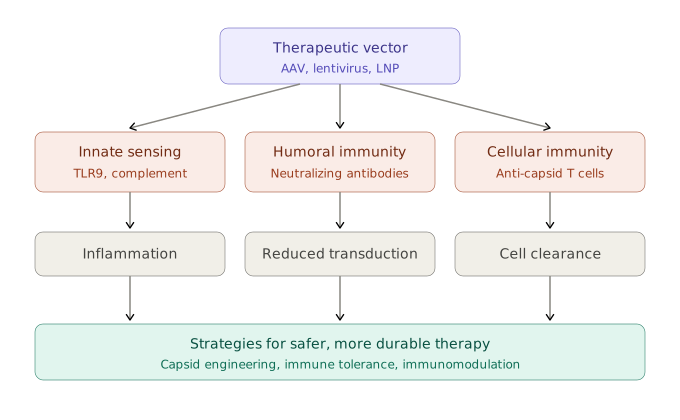
The immune system protects the body through coordinated mechanisms that recognize pathogens, damaged cells, and potentially harmful molecular structures. These mechanisms are also relevant to therapeutic gene delivery because engineered vectors and their components may activate immune pathways under particular conditions.
Immune recognition is not a single event. It involves multiple cellular and molecular processes that vary according to the delivery platform, route of administration, target tissue, genetic cargo, and previous exposure to related biological structures.
Innate Immunity
Innate immunity provides an early response to biological signals associated with infection or cellular stress. It involves physical barriers, complement proteins, inflammatory mediators, and specialized immune cells, including macrophages, dendritic cells, and natural killer cells.
Pattern recognition receptors, such as Toll-like receptors and selected cytosolic nucleic acid sensors, detect molecular features that may indicate the presence of foreign genetic material or infection.
Depending on the delivery system and its intracellular location, these sensing pathways may contribute to the production of type I interferons, inflammatory cytokines, and other mediators. Such responses can influence cellular activity, antigen presentation, and the subsequent development of adaptive immunity.
Innate immune activation is not necessarily equivalent to therapeutic failure. Its consequences depend on the strength, duration, location, and biological context of the response.
Adaptive Immunity
Adaptive immunity involves antigen-specific responses mediated by B lymphocytes, antibodies, and T lymphocytes.
B cells can differentiate into antibody-producing plasma cells following appropriate immune activation. Antibodies directed against a therapeutic vector may interfere with its interaction with target cells or reduce its effective availability. The magnitude and consequences of these effects depend on the antibody's specificity, concentration, and functional properties.
T cells contribute through several mechanisms. CD4-positive helper T cells coordinate immune responses, while CD8-positive cytotoxic T cells may recognize and eliminate cells displaying specific antigen-derived peptides on major histocompatibility complex molecules.
These processes are particularly important when evaluating viral vectors, because vector-derived proteins may become targets of cellular immune responses.
The relationship between innate and adaptive immunity is central to understanding immunogenicity in gene therapy. Early inflammatory signals can shape later antigen-specific responses, while previous immune exposure can influence how the body responds to subsequent treatment.
Immunogenicity:
A Central Challenge in Gene Therapy
Immunogenicity refers to the capacity of a substance or therapeutic product to induce an immune response. In gene therapy, it is a multidimensional phenomenon influenced by the delivery vehicle, genetic material, manufacturing characteristics, administration route, and biological characteristics of the recipient.
An immune response may be weak or strong, transient or persistent, and beneficial, neutral, or detrimental depending on the therapeutic context.
For example, immune activation may be desirable in certain cancer immunotherapy strategies. In other gene therapy applications, an immune response that reduces vector availability or damages cells expressing a therapeutic transgene may compromise treatment outcomes.

Pre-existing Immunity
Previous exposure to naturally occurring viruses can generate antibodies and memory immune cells that recognize related vector components. This is relevant to certain viral-vector platforms, including AAV-based systems.
Pre-existing neutralizing antibodies may reduce vector transduction under some conditions. However, the effect varies according to the vector, antibody characteristics, assay methods, and therapeutic context.
Assessing pre-existing immunity is therefore an important consideration in clinical development and patient selection for specific gene therapies.

Treatment-Induced Immunity
An individual may develop new immune responses after receiving a gene therapy product. These responses can target the vector capsid, vector-derived proteins, components of the delivery formulation, or the therapeutic protein produced following gene transfer.
Treatment-induced immunity may affect the persistence of gene expression, the availability of the vector, or the safety profile of the intervention.
Importantly, the presence of an antibody does not automatically establish clinical harm. Its functional properties, concentration, and relationship to relevant biological outcomes must be evaluated.

Immunogenicity and Therapeutic Efficacy
The relationship between immune recognition and efficacy is complex. A delivery system may achieve cellular entry but still trigger responses that limit the duration or magnitude of therapeutic gene expression.
Conversely, a relatively low measured immune response does not necessarily demonstrate that a product will be effective or safe.
A comprehensive assessment therefore considers immunological findings alongside biodistribution, target-cell transduction, gene expression, clinical outcomes, and adverse events.
Viral Vectors and Immune Recognition
Viral vectors have become important tools in gene therapy because selected viral properties can support efficient delivery of genetic material to particular cell populations. Their biological origins, however, create distinctive immunological considerations.
Adeno-Associated Virus Vectors
AAV vectors are used in several gene therapy applications because they can support gene delivery to selected tissues and may enable sustained transgene expression in appropriate settings.
The AAV capsid is an important target of immune recognition. Antibodies may bind capsid structures, and cellular immune responses may recognize capsid-derived peptides presented by transduced cells.
The magnitude and clinical significance of these responses vary with vector serotype, dose, administration route, tissue distribution, and individual immune characteristics.
AAV-based therapies therefore provide an important model for investigating the relationship between vector design, pre-existing immunity, and treatment-induced immune responses.
Adenoviral Vectors
Adenoviral vectors can support efficient gene transfer and are investigated in a range of therapeutic applications. Depending on the vector design and delivery context, they may stimulate innate immune pathways and induce antibody and T-cell responses.
Their immunological properties can influence both therapeutic applications and strategies involving repeated administration.
Understanding the interactions between adenoviral structures, host sensing mechanisms, and inflammatory signaling remains relevant to the design of delivery systems for specific clinical purposes.
Lentiviral Vectors
Lentiviral vectors are used in several gene-modification approaches, including certain ex vivo cell therapies. In these applications, cells may be modified outside the body and subsequently administered to the patient.
The immune implications depend on the vector system, the modified cell population, the genetic construct, and the treatment context.
Ex vivo delivery can alter the pattern of exposure compared with direct administration into the body, but it does not eliminate all potential immunological considerations.
Comparing these viral platforms demonstrates why vector selection must account for both gene-delivery performance and the biological consequences of immune recognition.

Non-Viral Delivery Systems and Their Immunological Properties
Non-viral gene delivery systems provide alternative approaches for transporting genetic material into cells. These platforms include lipid nanoparticles, polymeric carriers, and other engineered formulations.
Their immunological properties differ from those of viral vectors, but they are not necessarily immunologically inert.
Lipid Nanoparticles
Lipid nanoparticles are used to deliver nucleic acids, including messenger RNA and other genetic payloads. Their performance depends on formulation composition, particle properties, cellular uptake, intracellular trafficking, and release of the cargo.
The lipid components, nucleic acid cargo, and characteristics of the formulation can influence inflammatory signaling and immune recognition. Certain nucleic acid features may activate innate immune sensors, while formulation components may contribute to additional biological effects.
The overall response depends on the composition and characteristics of the product rather than on the delivery platform alone.

Polymer-Based Carriers
Polymeric systems can be engineered to support nucleic acid protection, cellular uptake, and controlled delivery. Their properties may be adjusted through changes in molecular structure, charge, size, and surface chemistry.
However, these same characteristics can influence interactions with plasma proteins, cell membranes, and immune cells.
Biocompatibility, degradation products, tissue distribution, and inflammatory responses are important factors in the evaluation of polymer-based gene delivery systems.

Molecular Mechanisms of Immune Recognition
The molecular mechanisms underlying immunogenicity connect the physical properties of delivery systems with cellular signaling and antigen-specific immune responses.
Recognition of Genetic Material
Cells contain molecular sensors that detect particular features of DNA and RNA. Depending on the molecular structure, cellular compartment, and delivery context, these sensors may activate signaling pathways associated with interferons and inflammatory cytokines.
For example, the cGAS–STING pathway contributes to the detection of certain cytosolic DNA signals, while other sensors participate in the recognition of RNA or related molecular patterns.
The activation of these pathways depends on the nature and location of the nucleic acid and the physiological state of the cell. Their involvement should therefore be evaluated in the context of the particular gene delivery system.
Antigen Processing and Presentation
Antigen presentation enables the adaptive immune system to recognize peptides derived from proteins.
Major histocompatibility complex class I molecules present peptides to CD8-positive T cells, while class II molecules present selected peptides to CD4-positive T cells.
Vector-derived proteins or newly expressed therapeutic proteins may contribute to antigen presentation under appropriate conditions. The resulting response depends on peptide characteristics, antigen abundance, antigen-presenting cell activity, and the immunological environment.
Complement Activation
The complement system is a network of proteins that contributes to immune surveillance, inflammation, and the removal of selected biological structures.
Some delivery systems may interact with complement components, potentially affecting their circulation, distribution, or inflammatory effects.
These interactions are formulation- and context-dependent, making complement assessment an important consideration for relevant products.
Cytokines and Inflammatory Mediators
Cytokines coordinate communication between immune cells and other tissues. Interferons, interleukins, tumor necrosis factors, and chemokines contribute to immune activation, cell recruitment, and the regulation of inflammation.
Changes in cytokine production can help characterize biological responses to gene delivery. However, individual cytokine measurements must be interpreted carefully because the same mediator may have different implications depending on concentration, timing, tissue location, and associated signaling pathways.

Assessing Immunogenicity in Preclinical and Clinical Research
Reliable immunogenicity assessment requires appropriate analytical methods, validated assays, and careful interpretation of results.

Antibody Testing
Antibody assays may measure binding antibodies or evaluate functional properties such as neutralization. These tests answer different questions and should not be treated as interchangeable.
Binding assays identify antibodies that recognize a particular antigen, while neutralizing assays assess the ability of antibodies to interfere with a defined biological process under specified test conditions.
Differences in assay design, sensitivity, specificity, and laboratory procedures can affect the comparability of results. Learn more
Cellular Immune Assays
Cellular immune responses may be evaluated using approaches that measure T-cell activation, cytokine production, proliferation, or other indicators of antigen-specific activity.
Methods such as enzyme-linked immunospot assays, flow cytometry, and selected functional assays can provide complementary information.
The interpretation of cellular immune data depends on assay validation, sample quality, timing, and the biological question being investigated.
Cytokine and Inflammatory Profiling
Measurements of selected inflammatory mediators may help characterize early responses following gene delivery.
However, cytokine concentrations can change rapidly, and measurements from blood may not fully represent immune activity within a target tissue.
Sampling schedules and analytical methods must therefore be appropriate to the expected kinetics of the biological response.
Integrating Laboratory and Clinical Evidence
Immunogenicity findings are most informative when interpreted alongside clinical observations, therapeutic outcomes, safety data, and relevant pharmacological measurements.
An antibody response, a cytokine increase, or a positive cellular assay should not automatically be interpreted as evidence of clinical harm.
Integrated assessment helps establish whether an observed immune response is associated with meaningful changes in safety, efficacy, or treatment durability.
Clinical Applications and Translational Research
Gene therapy is being investigated or used in selected clinical settings involving inherited diseases, hematological disorders, neuromuscular conditions, ophthalmic diseases, and certain cancers.
The immunological challenges differ across these applications because the target cells, therapeutic objectives, delivery routes, and required duration of gene expression vary.
For inherited diseases, the production of a previously absent or altered protein may introduce immunological questions that depend on the patient's underlying biology.
For ex vivo cell therapies, immune considerations may involve the modified cells, the genetic construct, the final therapeutic product, and the recipient's response after administration.
In oncology, the immune response may be part of the therapeutic objective in certain gene-based strategies. The challenge is to understand and manage the balance between intended immune activity and undesirable toxicity.
Translational research must therefore connect molecular findings to the practical requirements of clinical treatment. Laboratory observations can generate valuable hypotheses, but clinical significance must be established through appropriate studies.

Emerging Directions in Immunogenicity Research
The future of therapeutic gene delivery depends partly on a more detailed understanding of the relationship between engineered biological systems and human immunity.
Several research directions are contributing to this field.
Advanced vector design: Improved understanding of vector structure and biological interactions may support the development of delivery systems with more suitable tissue-targeting and immunological characteristics.
Precision medicine: Biomarkers and patient-specific information may help researchers characterize variability in immune responses and investigate more individualized treatment strategies.
Improved analytical technologies: More sensitive and standardized assays can strengthen the detection and interpretation of antibody responses, cellular immunity, and inflammatory activity.
Systems immunology: Integrating multiple types of biological data may help researchers investigate relationships between innate signaling, adaptive immunity, vector distribution, and therapeutic outcomes.
Alternative delivery technologies: Continued investigation of non-viral platforms and new formulation approaches may expand the options available for transporting genetic material into selected cells.
Long-term follow-up: For treatments intended to produce prolonged biological effects, understanding the durability of gene expression and the evolution of immune responses remains an important research objective.

Scientific Education and Knowledge Exchange
Understanding immune recognition in gene therapy requires knowledge from several interconnected disciplines. Molecular biology explains the behavior of genetic material and its expression, while immunology provides the framework for interpreting immune sensing, antigen presentation, and inflammatory signaling.
Bioengineering contributes to the design of delivery platforms, and analytical science provides the methods used to characterize product properties and biological responses. Clinical research then evaluates whether laboratory findings translate into meaningful outcomes for patients.
This platform is designed to bring these perspectives together through structured scientific content, conceptual explanations, and educational discussions of current research themes.
By organizing complex information into accessible sections, the resource aims to support students, researchers, biotechnology professionals, and readers interested in the biological principles of gene-based medicine.
Scientific understanding is strengthened through critical evaluation of evidence, attention to methodological limitations, and clear distinctions between established knowledge, ongoing investigation, and emerging hypotheses.
Our Scientific Perspective
The development of gene therapy requires a balance between effective delivery, appropriate biological activity, and an acceptable safety profile.
Understanding immune recognition is a key part of this challenge. Through a multidisciplinary perspective, this platform examines how molecular design and host biology interact, why immune responses vary, and how scientific research can help clarify the factors that influence therapeutic performance.
By emphasizing evidence-based interpretation and continued scientific inquiry, Decoding Immune Recognition in Therapeutic Gene Delivery aims to serve as a useful knowledge resource for the evolving field of genetic medicine.